

The Shoal #2 notes
Just wrapped up our second edition of The Shoal, and we discussed loads. The idea is simple: it’s an AMA (Ask A Member), where 15 Salmon Crew members bring a question and help each other. We’re doing these every two weeks.
Here’s a fancy pic of us all riffing on fun topics around life, work and the universe. If you want to come to the next one, make sure you’re a member of the Salmon Crew collective.
Or if you're an existing member, watch out for the next invite (probably next few hours).
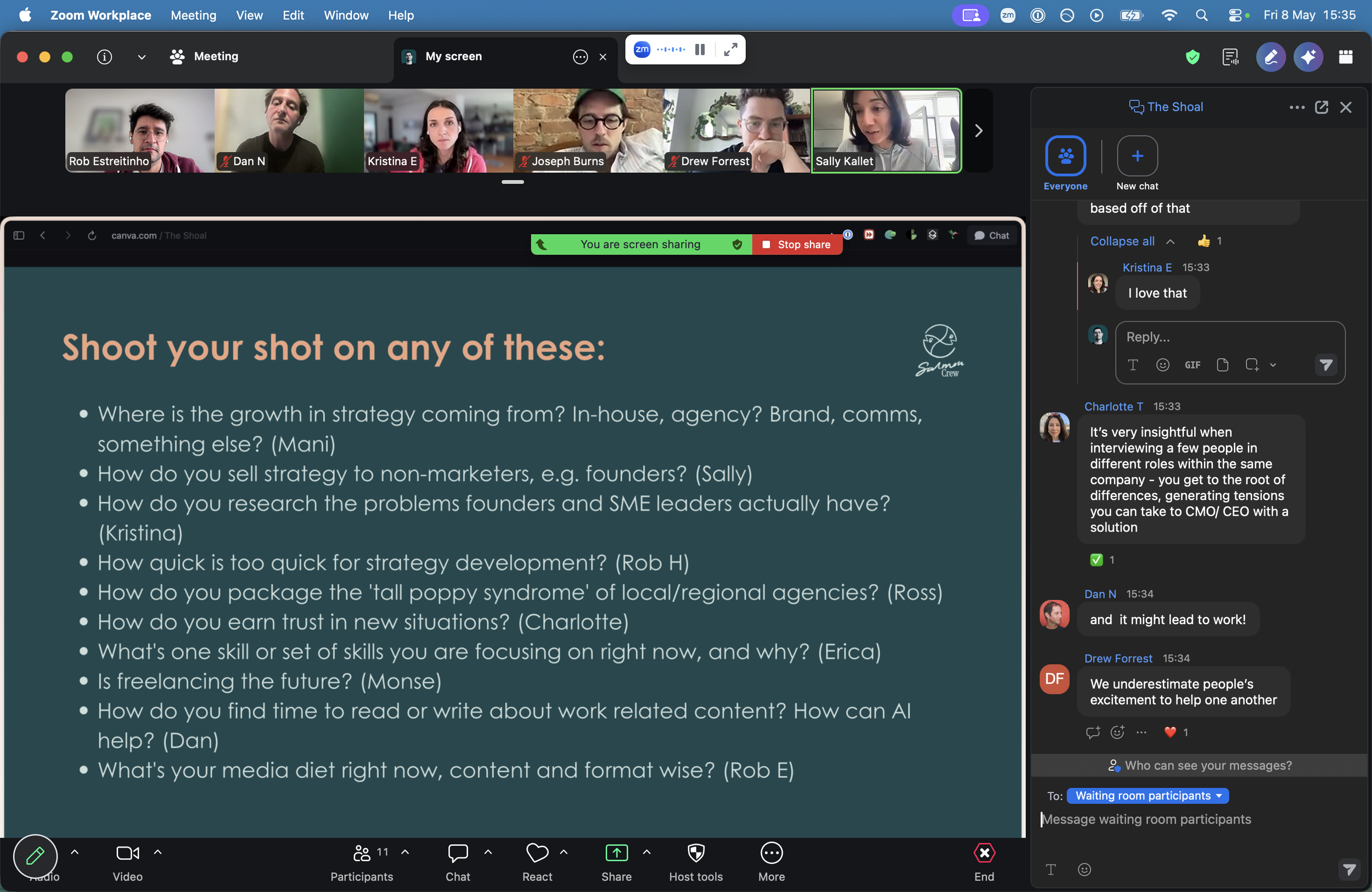
So, here’s a lil’ summary (terrible rapper name) of all the stuff we discussed. Optimised for practicality not just smarts.
Where is the growth in strategy?
Comms strategy has more frequent demand than brand strategy. Brand tends to be a once-every-few-years investment, whereas comms is ongoing, which matters a lot if you're billing by project.
The UK market feels particularly difficult. The more interesting opportunity is going direct to clients rather than through agencies, and looking beyond the UK.
No one cares about brand strategy on its own. People care about things linked to more direct outcomes and ROI. The framing and the link to commercial impact matters more than the discipline label.
Follow the money into growing niches. Even if that means pivoting away from sectors you love. B2B and food tech were flagged as more resilient right now compared to hospitality and food-and-drink, where thin margins are squeezing clients hard.
Beware of echo chambers when reading the market. It's easy to mistake what you're interested in, and therefore what you're being served, for what's actually growing. The algorithmically reinforced bubble can make trends look bigger than they are. Always good to compare notes with folks who don’t do what you do!
How do you sell strategy to non-marketers, e.g. founders?
Lead with the output, not the process. Founders respond to deliverables, e.g. a piece of language that rallies an internal team, a comms plan, a case study with what changed. Three words as an organising idea sounds absurd until you explain what it unlocks.
Don't pitch, interview. Asking someone if you can interview them for 30 minutes for research you're doing has a surprisingly high acceptance rate. People love talking about themselves and their problems. You're gathering intelligence, but you're also starting a relationship without the awkwardness of selling.
Offer something at the end. A good tactic after an interview is to offer the interviewee a free hour of your time to think through one of their problems. It rarely gets taken up immediately, but it seeds something, and you’ve already demonstrated your thinking during the chat.
Keep outreach short and punchy. Long messages trying to add value upfront don't perform as well as direct, low-stakes asks. "You seem interesting, can we chat?" works well enough. Brevity can signal confidence.
Position yourself as the expert from the start. Rather than waiting to understand a client's problems before offering a perspective, come in with a strong, named point of view, e.g. here are the three things startups get wrong about X. That posture opens doors in a way that "I'd love to learn more about your situation" does not. You may not always get it right, but now you’re having a tangible conversation about something they care about.
How do you productise strategy work?
Clients don't pay for thinking, they pay for artefacts. Strategists who can name a deliverable, scope it, and put a price on it are in stronger commercial positions than those who sell themselves as smart people available over a period of X amount of hours or days.
Build a menu of deliverables with prices attached. Going through your work and pricing each output, e.g. audience snapshot, comms framework, messaging matrix, gives you a ready-made proposal toolkit and makes scoping much faster. Also, see above: tangibility.
Productise what's labour-intensive, not what's core. Research, competitive reports, ongoing monitoring, these are good candidates for productised offerings. The actual strategic recommendation, the "this is what you should do", should stay fluid and expert-led. Productising that dilutes its value, so avoid doing it.
Aim for a “fast no”. Being opinionated early is a feature, not a bug. Clients who don't like your point of view aren't your clients, and finding that out in week one is far better than finding it out in month six. A “yes” is good, a “fast no” is good, a “slow no” is what’s terrible.
Add a socialisation phase. After delivering brand or comms strategy work, a short extension of scope focused on helping the internal team socialise the output is undervalued and undersold. The brand team in the room for a presentation can't always capture the reasoning for everyone else. Help them do that.
Don't over-productise. Too many products creates the same problem as too many flavours of jam, i.e. decision paralysis. Keep the menu focused. Starting with three core products is not a bad way to build your confidence.
How do we all find time to read stuff?
Make peace with not having all the nuance. The trap of reading is trying to absorb everything on the page and therefore feeling you’re never fully done. Instead, it’s ok to get the gist of things and the feeling that a piece of writing either introduced a new thought on your head, or it didn’t. AI summaries, in that sense, can help us have a much more varied and interesting media diet over time, not to mention a more sustainable one too. Probably.
How do you build your own profile?
Being known for something specific is more valuable than being broadly impressive. A precise area of expertise, e.g. a subculture, a sector, a type of problem, becomes a "category entry point" in people's minds. When they need that thing, they might think of you.
Content plus outreach beats either alone. Publishing on LinkedIn doesn't always lead directly to work, but it creates warm context and recognisability. When you reach out to someone cold, there's a chance they've already seen your thinking. The two work together.
Optimise your content for what excites you, not for what will perform. The best content often comes from genuine enthusiasm, and being a nerd about something, rather than trying to produce what seems absolutely correct or crowd pleasing. People can tell the difference.
Relational skills are increasingly valuable precisely because they're hard to automate. Active listening, creating psychological safety in client conversations, working with what's in someone's head rather than what they explicitly say, these are skills worth investing in alongside technical craft. Part of building a reputation is also being known as someone who’s easy to work with.
That's it for today. Loads to chew on, hope it helps you navigate the turbulent waters we now call this concept of a plan of a job market. If you want to come to the next private edition of The Shoal, I'd love to see you. Make sure you’re a member of the Salmon Crew collective.
Want more like this? Subscribe here: