
Don’t let AI become ultra-processed thinking
Been a bit lighter than usual on my writing because of prep work for my CCP masterclass (new tickets were made available!) and client delivery work, both of which gave me a thought over the weekend.
You know how it took us about two decades to work out that ultra-processed food was actually too good to be true? All that flavour, zero calories, zero sugar, zero fat, zero [insert whatever thing we have now determined is bad even tho anything in astronomical doses is bad], how can this be? Is this a modern miracle by any chance?
Well, yes, but also no. I prefer to see it as devil's bargain. Sure, I get to drink Diet Cokes and every now and then go to Five Guys (and I do, not trying to be a purist here), but the empirical evidence on what UPFs do to our bodies is only increasing. There are no free lunches.
It strikes me through that the same can be said for how we choose to integrate AI into our work diets. If a Big Mac is technically wonderful and yet devoid of proper nutritional value, the same can be said about outsourcing all your work to a LLM, just because you can.
Over on the Salmon Crew Slack there was a wonderful thread the other day about how to stipulate what AI is good for, and not, and how you get your team to use it without devaluing themselves in the process. I quite liked these two takes from crew members on finding a balance (anonymised because it is and always will be a safe space).
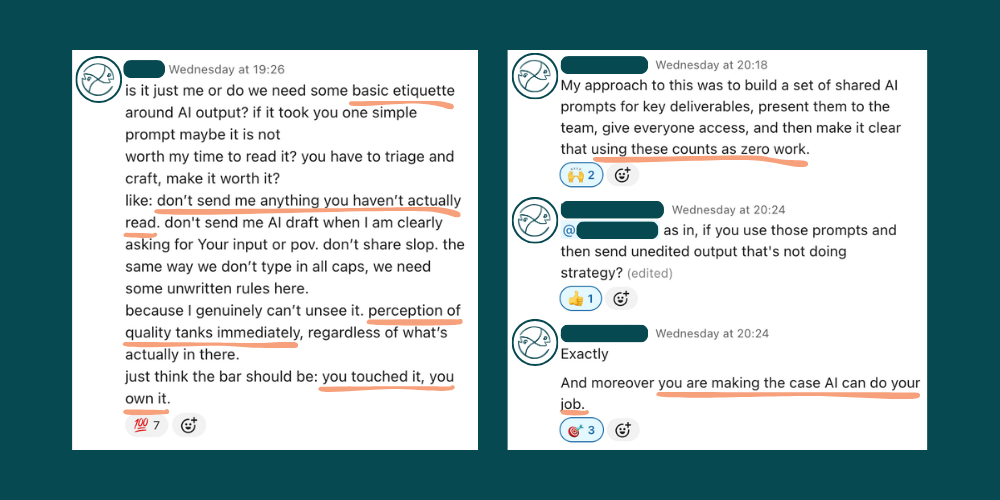
It's fascinating to see these things being negotiated as we go, but the negotiation does need to take place sometime. In the same way that I'm not saying you should drop all burgers and Diet Cokes from your diet, but for goodness sake don't have that as your breakfast.
In other words, we need to be careful that AI doesn't become a version of ultra-processed creative thinking, where technically it 'passes the bar' in terms of nutritional breakdown, and yet it creates a sense of cognitive atrophy that will in itself only lead to a range of second order effects, including perhaps work feeling meaningless.
My process with AI right now tends to be:
I start with a series of hypotheses and assumptions
Get AI to riff on them or research them while I do other stuff
Return to it and start debating with the tool until I get somewhere that feels true and meaningful
I feel the job is getting close to 'done' (for now) once I can implicitly understand it and can talk about it without any slides or supporting materials, it just feels natural and obvious to me
That is when I know it truly has my mark. Anything until that point may be intellectually there, but not fully there, because to truly know something I believe you gotta feel it in your body. That's my bar.
So if you do one thing after reading this... think about where you draw the line of what you use AI for, and where you intervene, and what your bar actually is. Moral codes on the topic will vary, that's ok, but what matters is that you do have an actual code to work with.
P.S. If you have thoughts on the topic, come chat them out in the Salmon Crew Slack. It's the high signal place you deserve right now.
Written by Rob Estreitinho, a comms and social strategy consultant and the founder of Salmon Labs. You might also enjoy getting my newsletter. 6,000 readers at a 60% open rate, read by agency and in-house strategy leaders from all five continents. Subscribe below.