

Why consultants fail at reading the room (and how to fix it)
As I write this, I’ve just finished the drafts of both a masterclass and a talk I am doing in Lisbon next week, for the Clube de Criatividade de Portugal. The masterclass (which I was told last night has sold out!) is going to be about how to avoid the Handover From Hell, and the talk about the rise of Tetris Teams.
It’s cool to reflect on these ideas on a couple of dimensions. First, the fact that they’re born out of explorations I’ve done in public, mostly through writing about things I observe either in the wild or in my client work, sometimes through events, definitely through riffing with the Salmon Crew. Second, the fact that they are both connected in the sense that they’re both about learning to read our social contexts so we can hold the right spaces for others to think.
The holding space business, or why context matters more than credentials
For months now I’ve been thinking about this term. “Holding space”. Sometimes in my own inner monologues I joke about how everything I do is at the service of the holding space business. I like to see myself as the guy who told Ray Kroc “you’re not in the restaurant business, you’re in the real estate business”, maybe because I secretly wish I were BJ Novak I dunno. But there’s a kernel of truth to it, because a lot of outside perspective is all about just that.
When clients hire me to work with them on their comms or content strategy, the premise is that this is now an environment where we can look at things with sufficient time and space to question which of them are still the right things. And often, a lot of them are right, but a lot of them require a bit of a reframe which only an outsider could offer – typically through a weird little metaphor, or wordplay, or reference points which are not what an ‘insider’ would entertain.
When consultants misread the room and our role in it
When I think about the Handover From Hell, I think about how the worst briefings I’ve ever delivered were the result of me not being able to read the social context in which they were being delivered. I both misunderstood the nature of the ask, but also the psychology of the team I was asking. Knowing your context and your casting is a crucial part of making the space you do hold indeed feel effective, as opposed to just another performative meeting.
Similarly, with Tetris Teams, the whole thesis is that we’re crossing the world of big jobs into a world where big jobs co-exist with lots of gig jobs. And gig jobs, like quantum physics vs Newtonian physics, follow a slightly different set of dynamics. For starters, it becomes more crucial to understand your role in a project regardless of what your supposed title for that project is on paper.
The Bluey project: a lesson in ego
Let me give you an example. A year or so ago, I got hired by a Spanish brand strategy consultancy to help them with a project for the BBC, specifically to help them codify the brand strategy for Bluey. Cool gig, right? But it started on a weird tone because the person I was working with clearly felt defensive about my involvement, as they were the strategy lead on it. What was that about?
Very simple. It became clear maybe 30 minutes into our kick-off call. They were afraid that, by being brought as outside help who understood the intricacies of the UK market, I was going to challenge the very premise of everything they’d been doing until that point. In crude terms, they were scared I was going to just shit on their work on the basis of “challenging the thinking” and putting my stamp on things. Because that is what a lot of consultants do.
It was a magnificent lesson to make it very clear among two people (and sometimes more) what the fixed and flexible elements of a project, and where it’s fair game to challenge vs where you ought to respect the political history of a project and which terrain offers diminishing returns if you trod on it right now. Basically, pick your battles, and know the specific role you’re there to play. To do this, of course, you gotta let your ego go for a second and just do the gig.
Know which consultant you need to be
In other instances, I’ve had clients who hired me because they needed my advice from the get go and frankly didn’t quite know where to start. In that scenario, it was less about working with what was there, and more about just openly challenging whatever needed challenging. Not because I was always going to get it right, but because that level of emotional honesty was important to ensure we were properly tackling the problem the way it should be tackled.
Another scenario that often happens is less about clients hiring me because they need me to tell them net new things, but more because they need to best understand how to defend the things they already know are the right things to do. And in those instances, on more than one occasion I’ve had clients say that a meeting with me felt like therapy. It’s just about the best feedback I can get, because it means people are comfortable enough to talk openly about what’s going on, and that’s half the battle when trying to solve a wicked problem.
In either case, understanding the shape of the game we were playing – the Tetris pieces if you will – allowed me to understand how to best fit into the game while still offering value within it. In comms strategy we talk about being able to signal the category (fit in) while being distinctive from it (stand out), and it strikes me that there’s a similar pattern here in terms of when clients hire you. Both at a pipeline development level, but also at a project delivery level.
Why reading the game beats being the cleverest person in the room
I often argue now that this ability to read the game you’re in is the beginning of knowing where you can add value. We can’t all be the mastermind on a project, even though a lot of the default mode for strategists is to try and be that. Sometimes it’s ok to play a support role in a bigger game, or facilitate all the excellent energy already on the table, and the then in next gig you get to be the person who defines the game worth playing like the badass you are. Or, as best defined by this framework we’ll go through in my masterclass, the role of strategy is directly related to which situation you find yourself in the first place. This level of adaptability is more important than ‘just being really clever’ IMO.
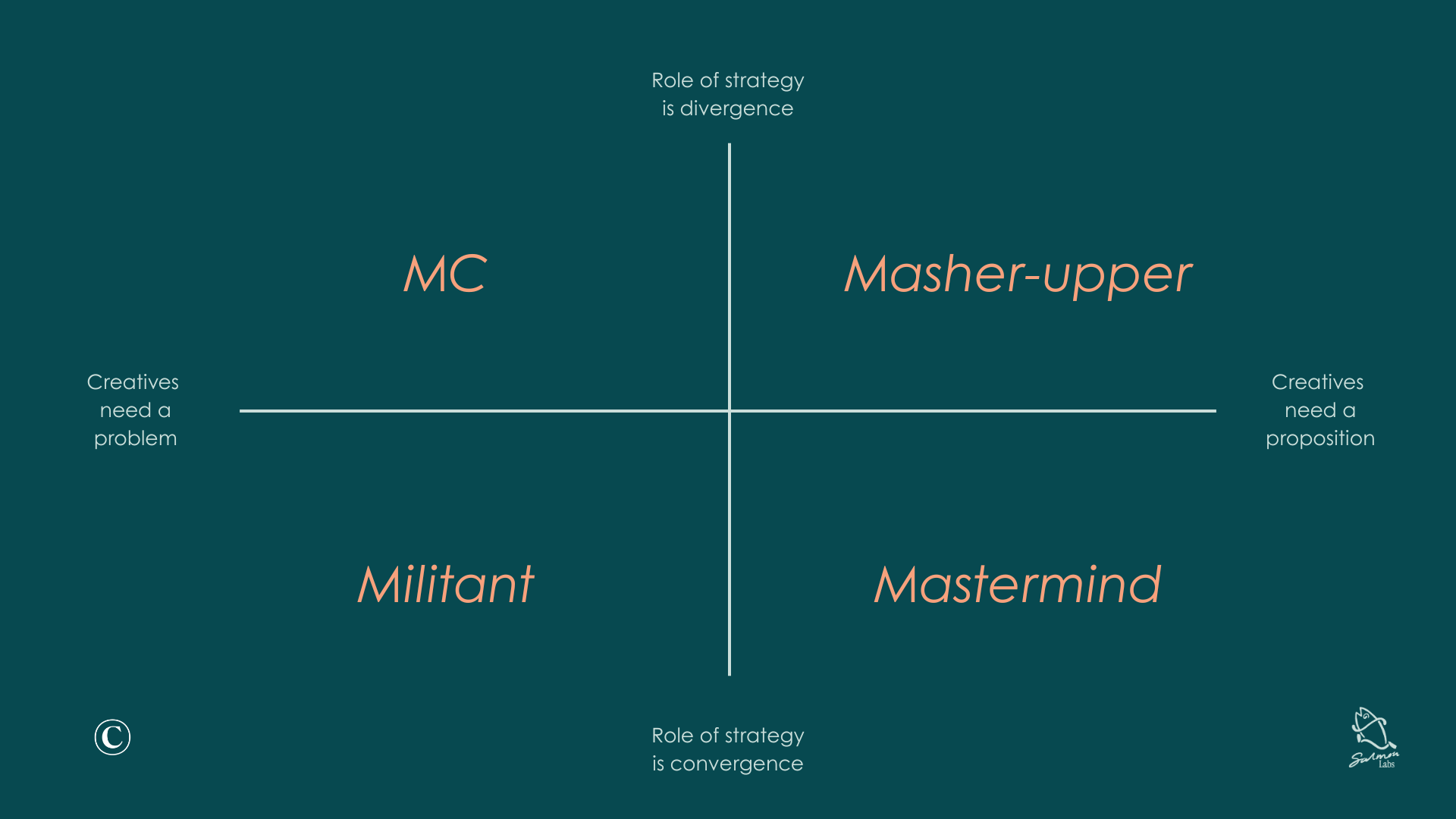
If you’re coming to the masterclass next week, thank you. I hope it’s helpful! If you’re not, and you want to better equip your brand, comms or social media team team for how to think strategically on the spot, we should be talking.
Written by Rob Estreitinho, a comms and social strategy consultant and the founder of Salmon Labs. You might also enjoy getting my newsletter. 6,000 readers at a 60% open rate, read by agency and in-house strategy leaders from all five continents. Subscribe below.