

Five brief notes from trying Zoe Scaman’s Whetstone AI
The below image will make no sense to you. Maybe that's the point. It's the exec summary version of what Zoe Scaman's Whetstone AI played back to me. It's basically a snapshot of the OS that makes my mind feel, well, mine.
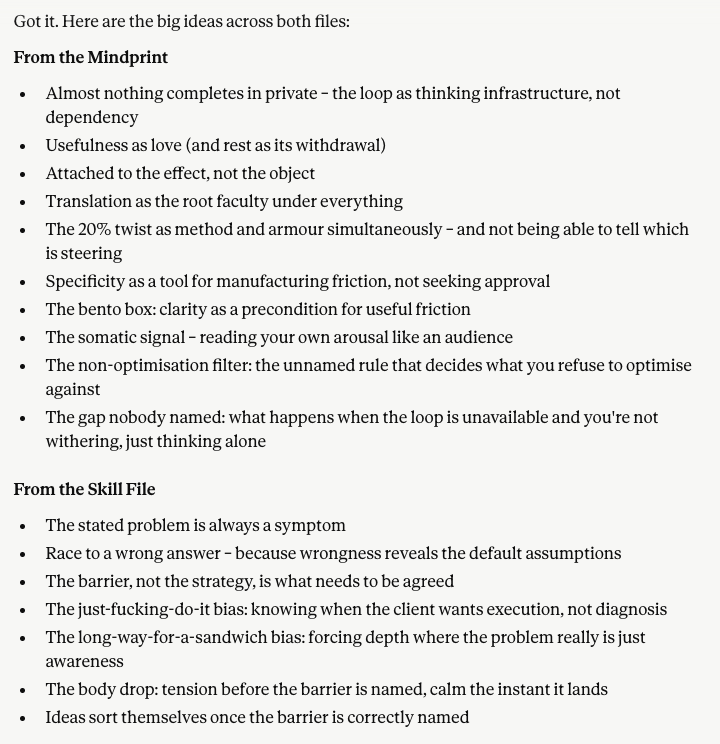
A few thoughts after having spent a few hours with it:
1/
The act of speaking, not typing, is interesting. It removes the self editing from trying to capture the words perfectly. My contributions to the tool were stumbley, full of ums and ahs, and that told me things. I self edit very little when writing anyway – stream of consciousness, yo – but this felt raw, and real. Your process may vary, which is why I encourage every strategist to build their own writing habit. There’s no right answer.
2/
It's basically like having a coach, without having a physical person in front of you. I have no idea if this is a good thing or not, maybe it's just a different thing. I've had coaches – hire Dana Stevens – and there are analogies to it. I guess the validation of another human felt more important to me than the validation of an AI system, but the documentation felt more accurate here to an extent. Something something about symbiotic relationship with the machines.
3/
One of the most interesting exercises for me was getting the tool to test me on my 'failure modes'. It's easy for an AI tool to pretend everything you said is wonderful and genius, because we all have perfectly rehearsed answers in our heads for a lot of work-related things. It felt refreshing to think about the ways in which my way of thinking might calcify over time, or when it's not as useful.
4/
It felt new and interesting and important to reflect on how I operate not just through the lens of how my mind works, but also what my body feels. That's the somatic bit there. Reflecting on how our body feels before a breakthrough, or after you've locked a core barrier, or after you see clients playing back your own language, is a useful exercise. Thinking is far more embodied than we think.
5/
I cannot tell you whether the price tag is worth it or not, because that's like asking if hiring a coach is worth it or not. It also really depends on your own financial situation and whether you can put it under a company expense or not. What I can say is that, after a couple of hours of using it, there were a few observations it played back that made me cry in the very best possible ways. Is that worth a couple of grand? I dunno, sometimes a good cry might yield dividends for a few years, so maybe over time it's actually a pretty decent deal.
Zoe didn't ask me to write any of this. But she did ask me to test her tool, and so I did, and because I have a compulsive need to document and collect pretty much everything, here you go. I probably am going on vacation with a greater sense of what makes me, me, and that's a generally good thing to have.
Whether that awareness means I'll stop myself from feeling bored for not having some sort of mental stimulation while chilling at the beach, that's a whole other situation. But maybe accepting this side of me is a good enough lesson for now.
Written by Rob Estreitinho, a comms and social strategy consultant and the founder of Salmon Labs. You might also enjoy getting my newsletter. 6,000 readers at a 60% open rate, read by agency and in-house strategy leaders from all five continents. Subscribe below.