Crew Wisdom: Ad industry, careers, self-care, ways of working+++
As the Salmon Crew approaches 250 paying members (seriously, wtf, and also ✨ thanks ✨), our private community is as vibrant as ever. But, as any strategist will know, all success unlocks new types of problems. In this case, it’s a lot to keep up with, including for me.
So, for the benefit of:
Existing members, who might have some serious FOMO
Non-members, who may be curious about the vibe
Myself, as Chief Completionist Officer in charge
Here is a list of the wisest and/or most counter-intuitive ideas I can’t stop thinking about, based on recent exchanges in the group, plus a few individual interviews I did with members Ally Waring, Christian Harrall-Baker, Jon Crowley and Perla Bloom (as a beta format).
To keep future conversations honest and protect people’s privacy, below is my interpretation of different members’ contributions, rather than their exact words. For that, the private group and swipe file, where I organise all individual member interviews, are your best bet.
Let’s get into ze goods.
How to think about the ad industry
It’s actually rebellious to be a “true believer” in advertising despite the industry having a terrible reputation and scrappy track record. Pushing down is not enough. Let’s push forward.
You can be both cynical and optimistic about the state of things. Cynical enough to realise you’ve got a problem, but optimistic enough to know the upsides are possible too.
The industry’s instability is an opportunity, because change only happens when existing models are proven ineffective. And we need to see that ineffectiveness in action a few times before we take it seriously. Survival’s a hell of a motivator.
Advertising is the opposite of the venture capital or pharma models. We can’t afford to be wrong 90% of the time hoping 10% makes up for it. Realising this makes market orientation a priority again, because that’s how we can improve our odds.
Ad industry publications obsess over insider concerns like holding company dynamics, while ignoring macroeconomic and geopolitical forces that actually shape the industry and our clients’ businesses. We need an Economist for marketing.
The Absolut Tabasco and BBC Winter Olympics campaigns are perfect examples of how proof of human craft will be a core part of how campaigns go live. “Thumbiness” is distinctiveness.
How to think about your career
AI-generated content and comments, for the sake of virality, strip any sense of genuine community or connection. Slop will by definition be a volume game, so soul and vulnerability will become the value game. This is how we can all keep winning.
Doubling down on our need for connection and to feel seen by others is a sustainable competitive advantage against AI. This is one of the reasons human therapy will continue to win, and AI therapy, while useful, will largely still feel like empty calories.
Defining yourself as a “slashy” is still seen by traditional employers as a net negative, but history will probably prove it’s a net positive. A wide range of skills will compound over time, and “slashiness” is probably a good predictor of lateral thinking.
You get to bash other people’s work if you can also show work that others can bash in return. Sounds harsh? Welcome to the game of “it’s hard enough to produce stuff without critics”.
You can offer more strategic value by being radically selective with your contributions, and offering context and synthesis for everyone else. This is not achieved by inhaling trend reports and obsessing over what’s new just because it’s new to you.
When we only reward certainty in an argument instead of giving people the benefit of exploration, we’re normalising fake conviction. This is the exact same thing we critique about AI.
One unsung benefit of AI is not that it can automate creativity, but rather that it can democratise people’s ability to visualise what’s already in their heads. That’s the bull case, anyway.
AI will only be able to fully replace strategy once it can understand the social context in which groups of people make decisions. The technical stuff may be more or less replicable, but the emotional, relational and social stuff, much less so.
Gaming isn’t less culturally relevant today, just less algorithmically rewarded since AI (and the metaverse) became the focus. Assuming things are dead because the discourse doesn’t reward them is how we erode our own value.
The only thing worse than challenging your audience is boring them to bits. True for ads but all forms of creative work, really.
How to take care of yourself
Most people over-estimate their capabilities until they face their own version of a challenge. Consider parenting. We all think we’d be great at it, but we’re comparing a perfect scenario with the reality of sleep deprivation and too much coffee.
It’s useful to think of ourselves, and the systems we live with, as best defined by points of failure, not points of success. “What would you do on your worst day?” is a far more useful question than “what would you do on your best day?”. AKA, resilience.
Knowledge and emotion are more embodied than we think. The body keeps the score, for good and bad, in how we process the world around us. This includes how we make sense of research, work best with others, and set our own boundaries.
When death either knocks on the door or threatens to, it’s natural that priorities change. Therefore, we all need to be more accustomed to thinking about the role of death in life whenever we wonder about why everything at work feels so hard. Sometimes the chemistry’s just not there, or not anymore.
It’s easy to be branded a “people pleaser” when all you’re after is to facilitate the right chemistry between different people. Doing great work while feeling chronically burnt out is not the flex the advertising industry continues to think it is.
How to think about ways of working
We’re so desperate to not repeat ourselves as marketers, we do loads more work that barely gets remembered. Repetition is how stuff wears in. No one is as bored of our work as we are.
Lack of strategy is random laziness. Strategic focus is smart laziness. Don’t reinvent the wheel when you can just refresh it. Specsavers has had the same brand line for 30 years. It works.
The fact social platforms are now more mature and boring is, in a way, a good thing. It means that marketers, agencies and strategists can spend less time getting distracted with shiny new toys, and can get far more effective with the toys they have.
Strategists should be involved throughout the production of the work, because otherwise it’s like saying you can construct a building while not inviting the original architect to have a look.
When clients love the strategy and hate the creative, this is not necessarily a talent issue. It’s more often a structural problem created by disconnected and dinosauric handoff models.
AI efficiency actually creates more work, not less, because when tools make things easier, the expectations of what can be done in the available time expand, so we do more of them.
High IQ, low ego
I am 100% biased but I will say this. The signal-to-noise ratio in the Salmon Crew is insane, and puts my public social feeds to shame. If you want to join the community, unlock my strategy swipe file, watch member interviews and join monthly events, now’s the perfect time to join.
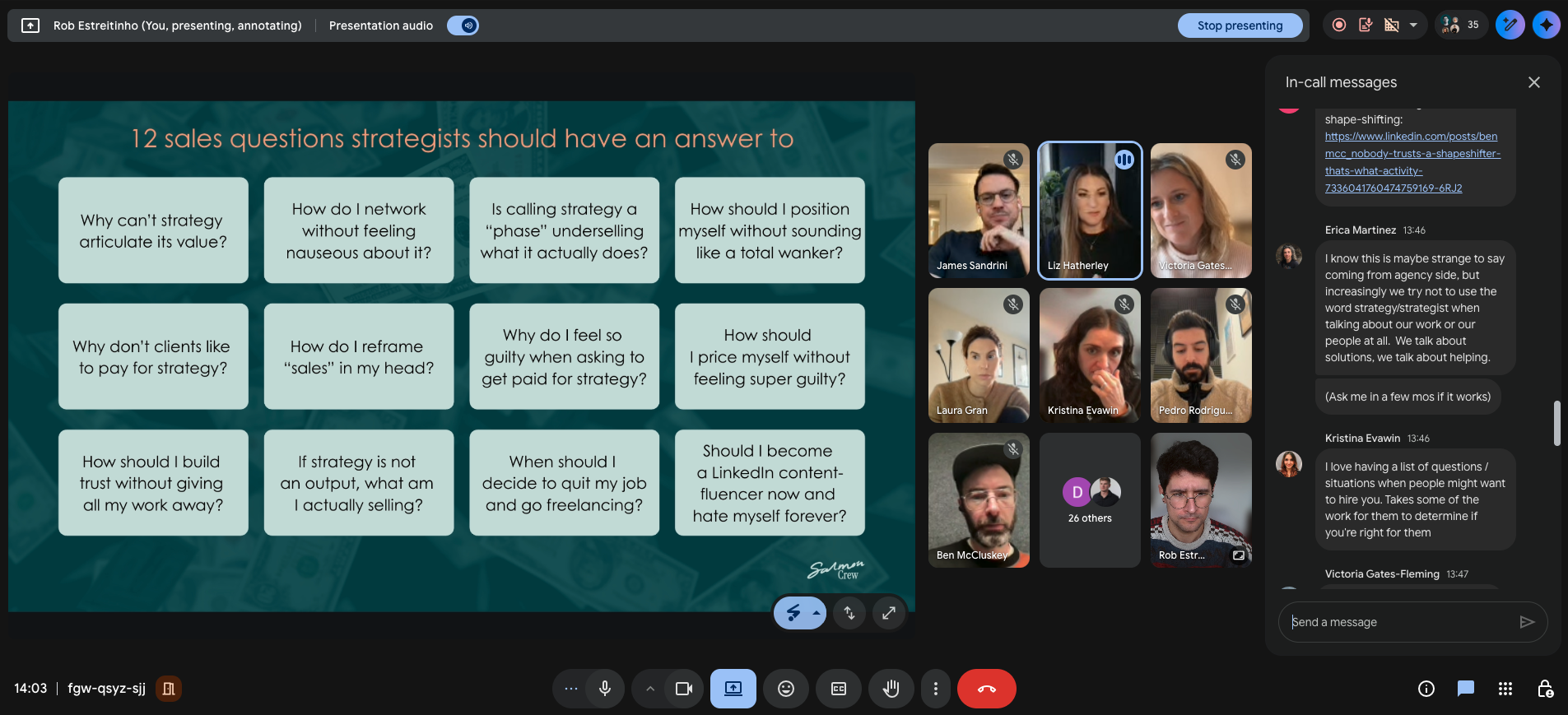
Every month the community votes on what they want to do next, and I invite members to co-run events with me. Very little ‘same big names as usual’ energy, lots of organic peer-to-peer learning. This was our latest one, on selling strategy. Write up, and February details, coming soon.
Thanks to the following Salmon Crew members for being consistently active and supportive in the community. Appreciate your energy.
Adam Ard, Adam Larter, Ally Waring, Amy Daroukakis, Ben McCluskey, Bruno Simões, Bogdan Șuică, Christian Harrall-Baker, Danusia Smith, Dave Rapson, Hemal Gill, Honza Marcinek, Jared Clark, Jon Crowley, Joe Burns, Joel Stein, Kirsten Larson, Kit Altin, Kristina Evawin, Lara Cory, Liz Hatherley, Lou Goodman, Matthew Linnett, Nicole López, Nikunj Agarwal, Perla Bloom, Pollyanna Ward, Robert Hall, Robyn Mays, Ross MacDonald, Soner Tehelcioğlu, Suzi Tennant, Theo Cooper, and Theophilus Wells IV. Among others I probably missed.