

What a masterclass taught me about the least wrong version of an idea
So as I was delivering my masterclass at the Clube de Criatividade de Portugal, I both felt that I had rehearsed it well enough to do a good job, but also that I was learning in real time what actually worked about it.
I could easily come here and say it was a huge success and boom we’re ready to do it again, but the reality is that while I got a lot of good feedback I also got a very visceral sense that, as I was taking folks through my ways of thinking about the Handover From Hell, some of them held up to scrutiny more than others.
This was the framework I introduced, before getting into some detail about the playbook for each archetype and examples of how I had to play that role in client work in the past, before getting people to practice.
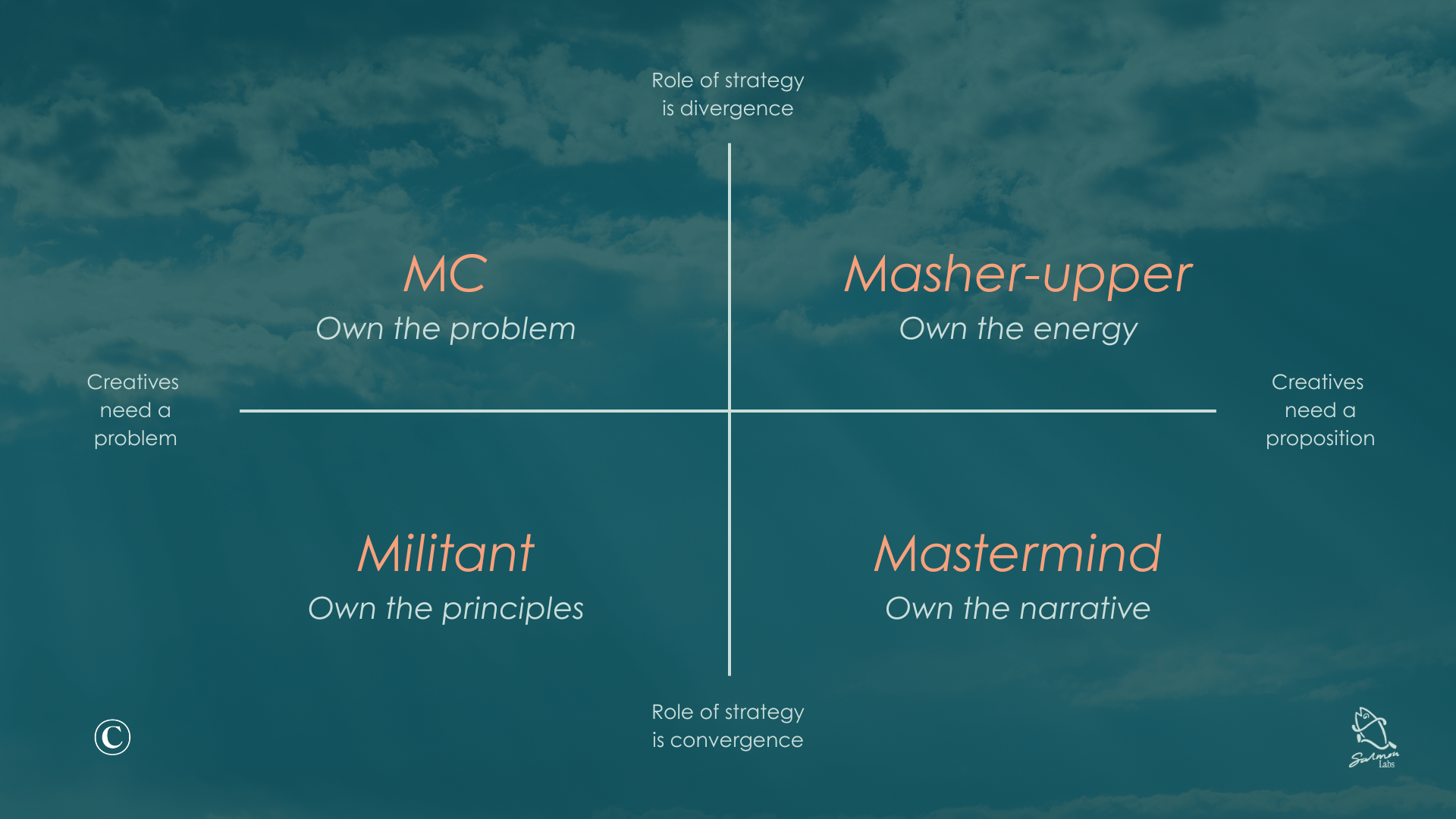
And while I’d say directionally this is probably not wrong, it’s also not quite complete either. I wasn’t going for an ultimate thesis of course, because everything we do is always the least wrong version of the thing, but a few questions emerged even as I put some of this into practice with people:
Are we saying these are a sequence of roles we play in a project, or are there projects where you’re only required (or allowed) to play one of the roles? Is there a way to diagnose which projects require what?
Where do client expectations come into this, especially if you’re working directly with marketing teams? If you’re not briefing a classic creative team but a cross-functional team, what is the X axis for it?
Is there really such a big difference between the Militant and the Mastermind archetype? Sure, one of them might be more an enforcer of what’s there and the other is more about enforcing while also setting the vision, but are they two sides of the same coin?
Is the role of the MC to own the problem or to actually own the energy, regardless of if we have a clear problem or a clear proposition, and the Masher-Upper is more of a co-creator role instead of just a facilitator role (which is what the MC is)?
Now, I’m not sharing this to under-sell everything I said in the masterclass, quite the contrary. It’s a 70% correct basis on top of which I am now able to build, thanks to the feedback that was both explicit (what people said) but also implied (how people responded to the exercises).
But it does make me think that every time I put something down for a post, or a newsletter, or an event, or a masterclass, or a talk, all we ever have is the least wrong version of where our head’s at. And then the acid test of actually showing it to people gives us the blind spots we truly need.
Want more like this? Subscribe here: